Community
Opening Access to CarrotFunding: The Next Generation of Modern Prop Trading
Opening Access to CarrotFunding Over the last few years, modern prop trading became one of the fastest-growing categories in retai...
Read article

Most prop firms only know one direction for fees: out of your pocket. On carrotfunding, the fee can flow the other way. Let’s deep dive into the Hidden Edge.
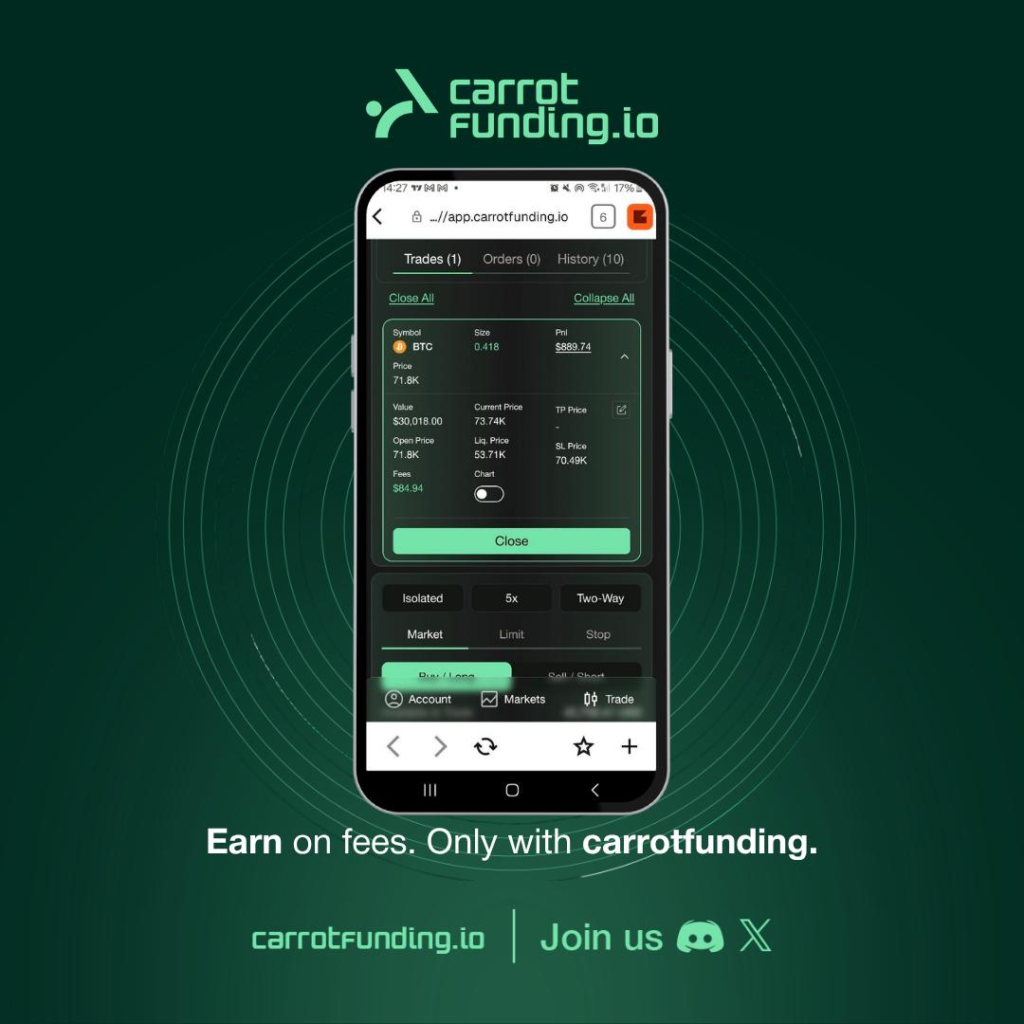
A few days ago, one of our traders went long $BTC at $71,800. The trade ran for four days, BTC pushed to $73,740, and they closed up $889.74 in PnL. Standard funded-trader story. Until you look at the fees column.
+$84.94 in fees. Earned. Not paid.
That’s not a glitch in the dashboard. It’s the funding rate doing what it was designed to do.
Here’s how it actually works.
Perpetual futures don’t expire. That’s the whole point. You can hold a leveraged position for days, weeks, or months without rolling contracts. But this creates a problem: there’s no settlement date to anchor the perp price to spot.
So perpetual exchanges use funding rates. They’re periodic payments that move between long and short traders to keep the perp price tethered to the underlying spot market.
The mechanic is simple: when one side of the market is heavily skewed, the dominant side pays the smaller side a fee for taking the opposite trade. If everyone’s long, longs pay shorts. If everyone’s short, shorts pay longs.
It’s the market’s way of bribing someone, anyone, to balance the book.
On most prop firms, fees are a one-way street. Spread, commission, swap, holding fees. They drain your account whether your trade wins or loses. Funding-fee mechanics don’t exist because most prop firms route through brokers that don’t expose them to traders, or they’re netted out internally and never passed through.
Carrotfunding is different because we don’t run on a broker. We run on gTrade by @GainsNetwork_io. An on-chain perpetual futures protocol. That means every funding rate, every skew adjustment, every payment between longs and shorts happens at the protocol level, transparently, and the trader on the right side keeps the funding fee.
So when our trader went long BTC and the rest of the market was piled into shorts, they weren’t just betting on price. They were getting paid by every short on the platform to hold that long position open.
For four days, that paid out $84.94.
gTrade migrated to its v10 funding fee model in August 2025, replacing the older borrowing-fee-only system on major pairs. The current model works like this:
1. Skew is the input.
The protocol measures the imbalance between long and short open interest on each pair. The bigger the skew, the bigger the funding rate.
2. The velocity model controls the speed.
Rather than spiking funding rates the moment a market gets imbalanced, v10 uses a velocity-based model. Fees adjust progressively based on market skew: the greater the imbalance, the faster the change. Instead of sudden spikes, funding rates evolve over time, creating a more stable trading experience.
This matters for funded traders. It means the funding edge is real and capturable, not a flash payment that disappears in a single block.
3. The dominant side pays the minority side.
If longs dominate open interest, longs pay funding. Shorts receive it and vice versa.
Let’s be clear about what just happened in that BTC trade.
The trader didn’t just get lucky. They were:
That last point is what most traders miss. Funding fees are a time-based edge. The longer you sit on the right side of an imbalance, the more it pays. On a $30k position, $84.94 over four days is roughly an annualized 25%+ on the funding component alone, before you’ve taken a single dollar of directional PnL.
For traders who already think in skew, basis, and positioning this is free money. Most of them just don’t have access to it on funded accounts.
On carrotfunding, you do.
A few things to know if you want to harvest funding fees on a Carrot challenge or funded account:
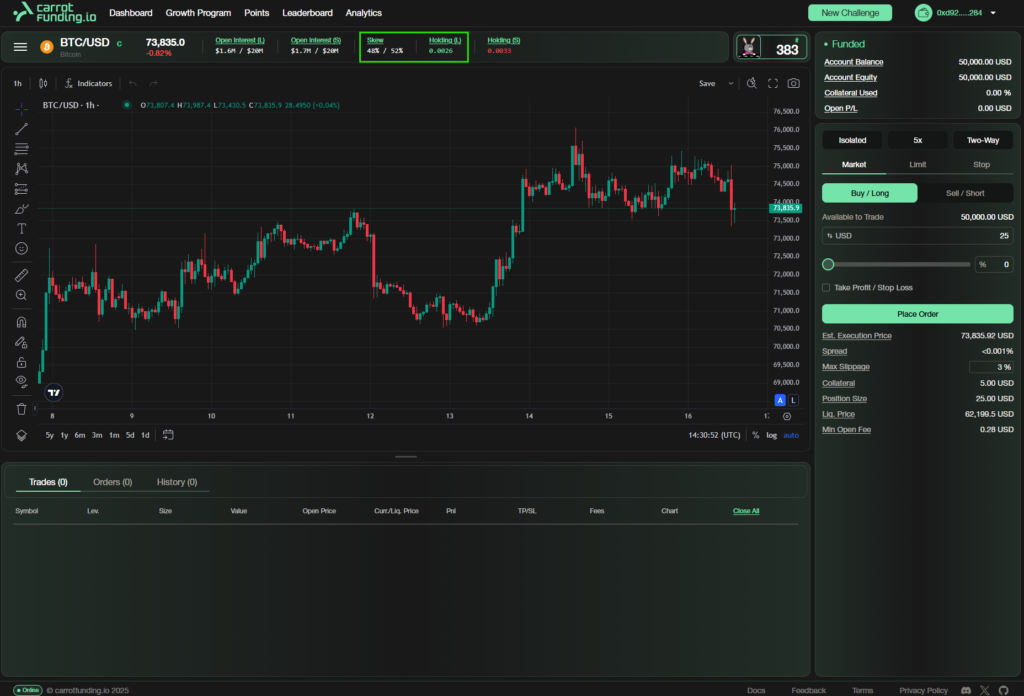
Read the skew before you enter. gTrade’s interface shows long/short OI for every pair. If the book is heavily skewed and you have a directional thesis that aligns with the minority side, you’re stacking edges.
Hold long enough for it to matter. Funding compounds over time. Scalping in and out kills the funding edge. This is a swing trader’s tool more than a scalper’s.
The reason carrotfunding can offer this isn’t marketing. It’s architecture.
When your prop firm is based on a real on-chain perpetual exchange, every protocol-level mechanic like funding rates passes through to the trader. There’s no middle layer extracting it. No broker netting it out. No “we keep the funding, you keep the PnL” sleight of hand.
You get the full DeFi-native trading environment, with funded capital sitting on top.
That’s the difference.