Community
Opening Access to CarrotFunding: The Next Generation of Modern Prop Trading
Opening Access to CarrotFunding Over the last few years, modern prop trading became one of the fastest-growing categories in retai...
Read article

4,000 users. 150 survey responses. One product, built around what they actually want.
After more than a year in closed beta – testing infrastructure, refining mechanics, and quietly funding a small group of traders – CarrotFunding is opening its doors for everybody.
Before flipping the switch, we did something most prop firms never bother with. We asked traders what they actually want. Not in a focus group. Not behind a paywall. A simple ten-question survey, sent to our community.154 traders responded. The data confirmed what we already suspected and gave us the conviction to ship a product that looks nothing like the standard prop firm template. Here’s what they told us, and what we built because of it.
We asked traders to pick the three things that matter most when choosing a prop firm. Out of twelve options. Covering price, profit split, platform quality, drawdown rules, and asset selection. One answer dominated everything else.
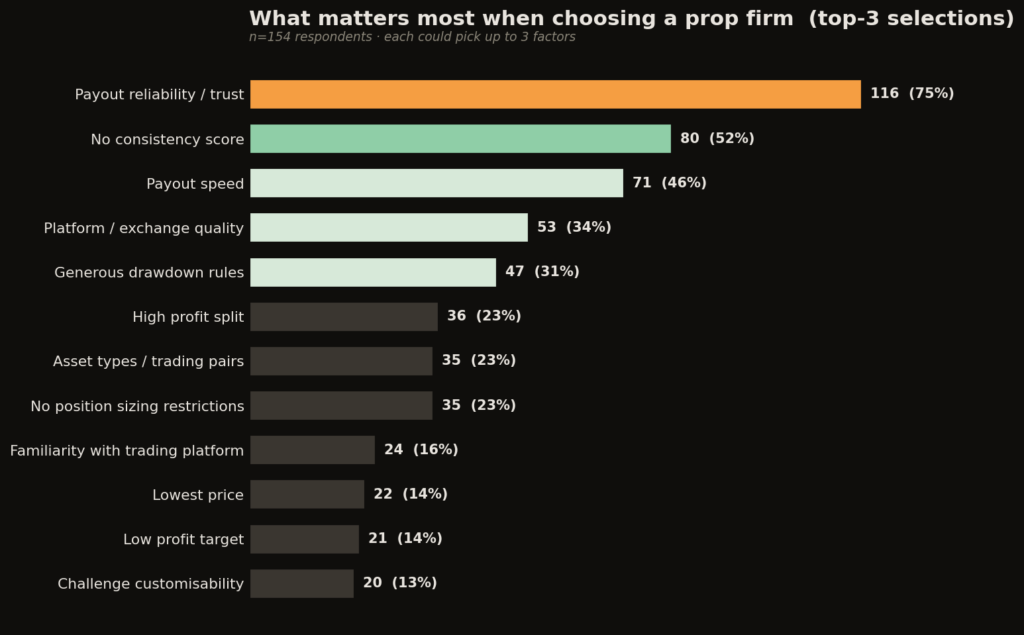
75% ranked payout reliability and trust that they’ll actually get paid in their top three.
Not price. Not profit split. Not platform quality. Trust.
This is the entire industry’s problem in a single data point. Traders aren’t shopping for the cheapest challenge or the highest leverage, they’re shopping for a firm they believe will pay them when they win. And the reason they’re shopping at all is because most firms have failed at exactly that.
When the #1 thing your customers want is to be confident they’ll get paid, that tells you everything about the industry they’ve been forced to operate in.
If trust is the priority, the next obvious question is: why? We asked directly.
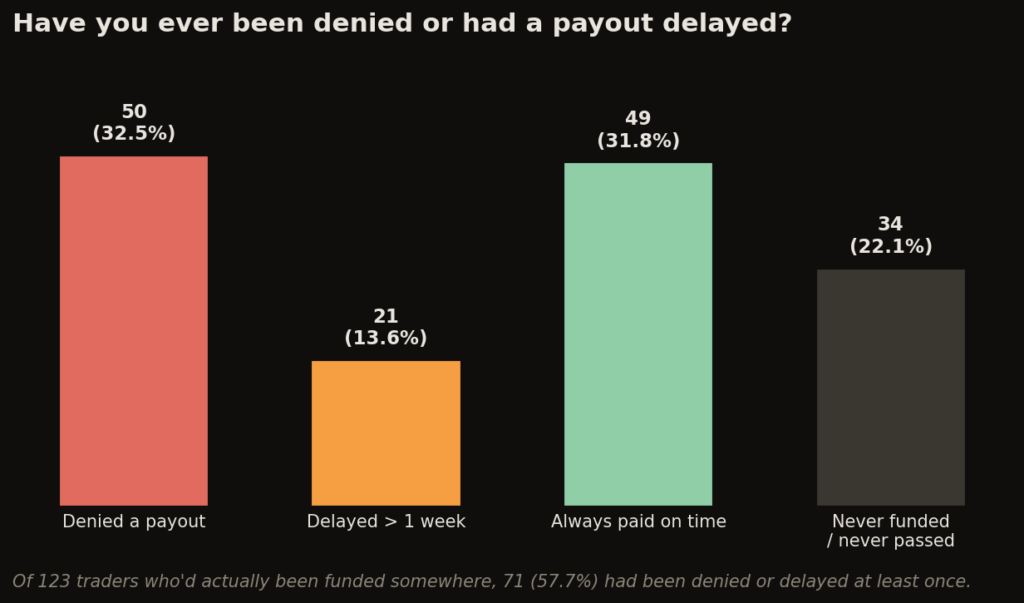
Of the 123 traders in our sample who’d actually been funded somewhere, 71 had been denied or significantly delayed on a payout — 57.7% of the funded population. Almost half of all respondents (46.2%) had personally experienced a denied or delayed payout.
57.7% of funded traders have been denied or delayed on a payout.
This is not a fringe complaint. This is the median experience. The standard interaction with a prop firm now includes the realistic possibility that you’ll be denied your earnings under a fine-print clause you didn’t notice when you signed up.
It’s also why every prop firm landing page now leads with screenshots of recent payouts, because the industry’s customers fundamentally don’t believe the headline numbers without proof. The moment payout proof becomes the primary marketing asset, you know the underlying trust is gone.
Stop telling us, prove it.
There’s a less-discussed problem behind the payout question: in many prop firms, your trades never actually hit the market. Instead, the firm acts as the counterparty. They book your trades against their own book, a model called “A/B booking,” where profitable traders get routed to the live market (A book) and unprofitable ones are kept internal (B book).
It’s a legitimate business model. But it creates an inherent conflict of interest: the firm now profits when you lose. And most firms don’t disclose which book you’re on. But in practice, most traders are B-booked. In that model, top performers become a liability, which is exactly why opaque rules and retroactive denials tricks exist. They’re not edge cases. They’re the business model defending itself.
So we asked: does it actually matter to you whether your trades hit real markets?
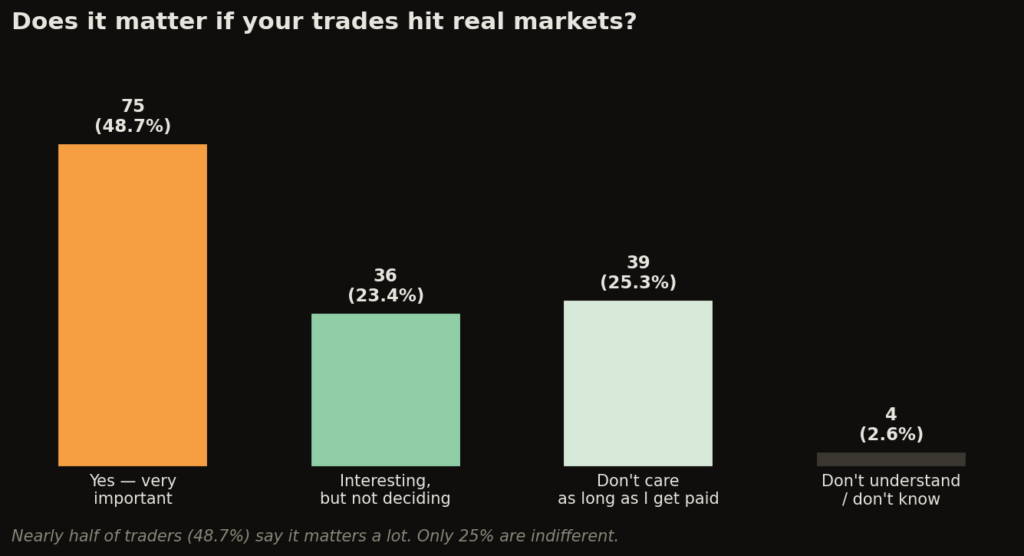
48.7% of traders say real-market execution matters.
Nearly half of traders consider real-market execution a deciding factor. Another quarter find it interesting but not deciding. Only a quarter are openly indifferent. And of those indifferent, most explained their position with the same phrase: “as long as I get paid.”
Which brings us back to the trust problem. Indifference to A/B booking isn’t really indifference, it’s resignation. Traders have stopped expecting transparency on execution, the same way they’ve stopped expecting reliable payouts.
Carrotfunding runs a hybrid model. Top performers don’t become a structural liability, there’s an actual path to the A book, and you can see it on-chain. Orders settle against oracle-driven price feeds via gTrade, not internalized silently against our book. You don’t have to trust us on this. You can verify it block by block.
If A/B booking is unavoidable in some form across the industry, the next question is whether firms should at least be transparent about it. We asked traders to rate the importance of transparency on a 1–5 scale.
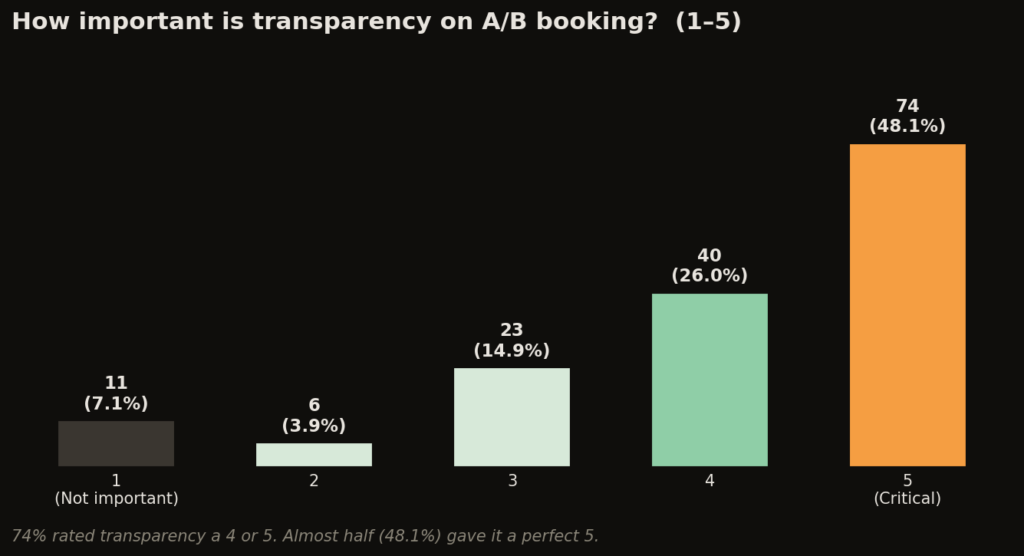
74% rate transparency on A/B booking a 4 or 5. 48% give it a perfect 5.
Three quarters of traders consider transparency critical or near-critical. Almost half rate it a perfect 5. Only 11% rate it below 3.
What’s striking is that this is a conceptually advanced topic. A/B booking isn’t well understood outside the most experienced trader population. The fact that 74% rate it a 4 or 5 suggests something deeper: traders may not know the technical mechanics, but they intuit that something is being hidden from them. They want it shown.
Our response is to go further than disclosure. We’re publishing what it actually takes to become an A-booked trader on Carrot. The metrics, the thresholds, the routing logic out in the open, in our docs and on-chain. If you trade through us, you’ll know exactly which book you’re on and why.
Consistency score is one of the most controversial mechanics in modern prop trading. The premise is reasonable — if you make all your profit on a single lucky day, the firm has a hard time underwriting the risk on a funded account. The execution is where it falls apart. Most consistency rules are opaque, retroactively applied, and used as a convenient reason to deny payouts.
We asked traders directly what they think of it. Out of twelve options for what matters most when picking a prop firm, “no consistency score” was the second most-selected answer — chosen by 52% of respondents.
52% of traders explicitly want no consistency score.
That’s a higher selection rate than payout speed, drawdown rules, profit split, or platform quality. The only thing more important to traders than getting rid of consistency scores is being paid at all.
So at launch: the consistency score is gone for our 2-step challenges. On 1-step challenges, it’s eased significantly – high enough to prevent gaming, low enough that disciplined traders never hit it. We’ll publish the exact thresholds in the docs.
CarrotFunding was designed from day one to address the four problems above not as marketing positioning, but as architecture. The survey didn’t change the product. It confirmed we were building the right one.
Payouts settle to your wallet on-chain, with full transparency on the flow. We still review every payout request manually – not as a gatekeeping exercise, but as a final integrity check. The difference is the timeline: payouts are processed in under 24 hours, end to end.
Challenge passes are evaluated using cryptographically verifiable compute on Oasis ROFL infrastructure. The evaluation logic is open. The output is signed. We could not deny a passing challenge if we wanted to – and we wouldn’t want to. Our incentive is to fund profitable traders, not to prevent them from getting funded.
Trades route through Gains Network’s gTrade infrastructure with Chainlink oracle price feeds. 290+ pairs across crypto, forex, commodities, stocks, and indices. No internal market-making. No A/B routing surprises.
Both challenge tracks are now meaningfully friendlier than industry standard. The thresholds are published. There’s no surprise denial mechanism waiting at the end of a successful challenge.
Every Carrot trader gets a Funded Bunny Initiative NFT that evolves with their challenge stage and PnL. It’s cosmetic, but it’s also a portable, on-chain record of what you’ve actually done as a trader. The kind of credential the prop industry has never been able to issue.
We didn’t run a closed beta to manufacture exclusivity. We ran one to make sure the infrastructure worked under real load with real traders. It does.