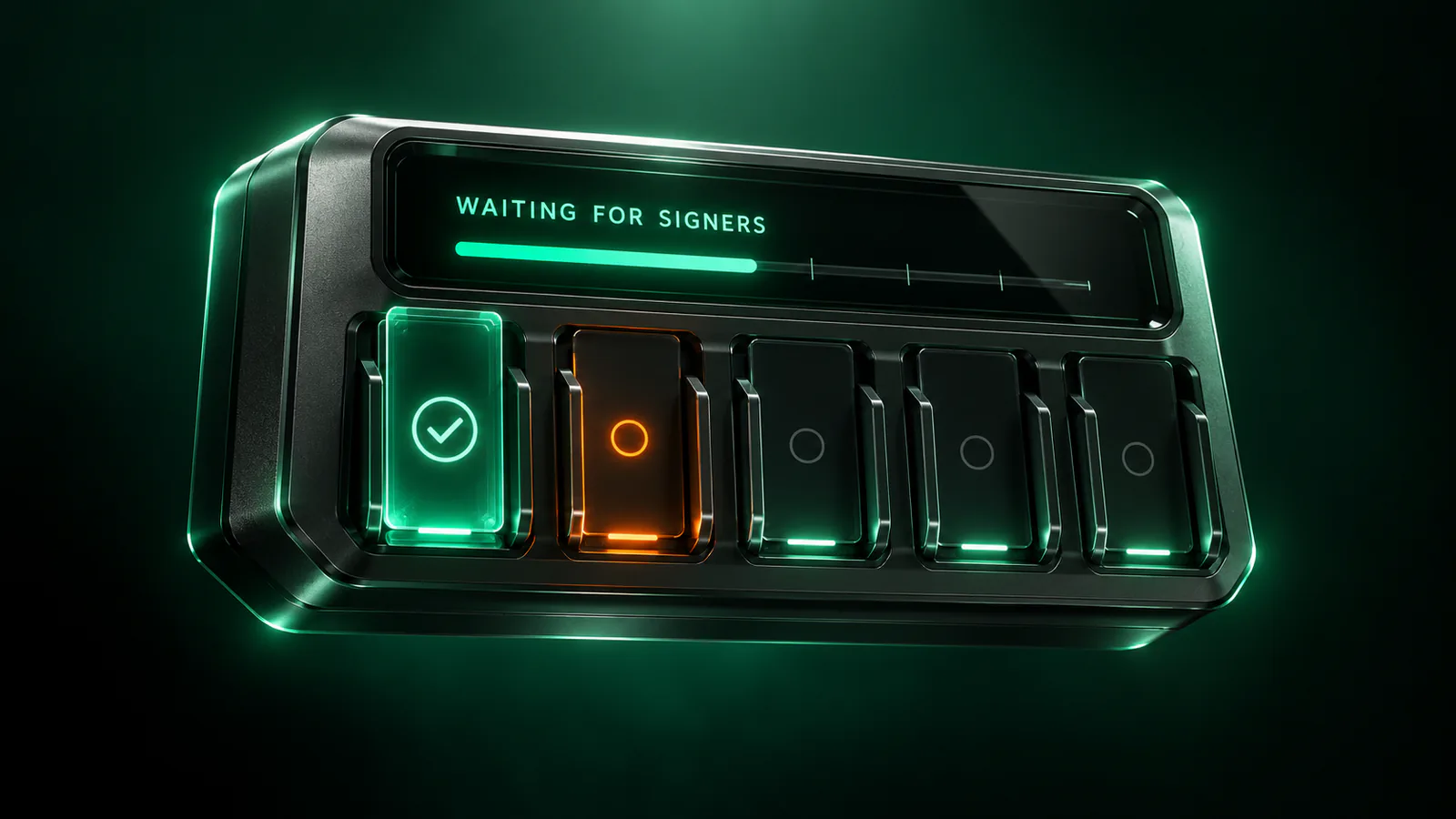
An ordinary wallet answers one question with one key. Whoever holds the private key can sign, and whatever they sign goes through. That is simple, and it is also a single point of failure. Lose the key and the funds are stuck. Leak the key and someone else can move them.
A multisig wallet changes the rule. Instead of one key, it needs approvals from several keyholders before anything moves. The question shifts from "who has the key" to "how many of them agree".
This piece stays vendor-neutral. It explains how a multisig works, how the threshold is chosen, what it protects you against and what it leaves open. You do not need to set one up to follow it. You need to know what the setup promises, so you can tell when a claim about it means more than it says.
Key Takeaways
- A multisig moves funds only after a set number of keyholders out of a larger group approve the same transaction.
- The threshold trades protection against theft for protection against lost keys; you cannot maximize both.
- A multisig counts keys, not people: if the signers are not independent, the real protection is weaker than the written rule.
- For a contract-based multisig, the threshold and the signer addresses are usually readable on-chain; the people behind them are not.
- When a firm says payouts need several signatures, ask for the threshold, the number of signers and where you can check both.
What a Multisig Wallet Is
A multisig, short for multi-signature, is a wallet with a rule attached. The rule names a group of keys and a threshold. A transaction is valid only when it carries approvals from at least that many keys in the group.
People usually write this as m-of-n. The n is the size of the group, the m is how many approvals a transaction needs. Each key is held by a signer, which can be a person, a device or a service.
From the outside, a multisig looks like any other wallet. It has an address, it can receive funds, and anyone can look up its balance. The difference only shows when funds leave. One signature is no longer enough. A single signer can propose a transfer, but nothing moves until enough others have signed the same request.
Depending on the chain, the rule lives in different places. Some networks support multisig directly in how they check transactions. Others implement it as a smart contract that holds the funds and checks approvals before it releases them. For you as a user, the effect is similar. For the risks, the difference matters, and we come back to it below.
How a Multisig Transaction Moves
A transfer from a multisig is a process with several steps rather than a single click. In most designs it runs like this:
- A signer drafts the transaction: the recipient, the amount and anything else it should do.
- The draft is shared with the other signers, often through an interface built for that wallet.
- Each signer reviews it and signs with their own key. Signatures are collected, not combined by hand.
- Once the threshold is met, someone submits the transaction with its approvals.
- The network or the contract checks the approvals and executes the transfer, and the result is recorded on-chain.
Two things follow from this. First, every transfer passes at least one extra pair of eyes before it settles. Second, it takes longer. Signers need to be reachable, and someone has to coordinate them. That delay is not a flaw. It is the price of the check. Safety costs time.
Choosing the Threshold
The threshold is the most important number in a multisig. It decides how many keys an attacker needs, and how many keys the owners can afford to lose. Those two pull in opposite directions. You cannot have both.
A high threshold makes theft harder. An attacker has to compromise many keys, not just one. But every lost key brings the wallet closer to the point where nobody can reach the threshold any more. At that point the funds are frozen, for good.
A low threshold makes the wallet resilient to lost keys. The owners can lose several and still operate. But an attacker needs fewer keys too, and in the extreme case a single stolen key is enough.
A threshold between the extremes avoids both failure modes. A majority threshold keeps theft hard while leaving room for a lost device or an unreachable signer. Which balance is right depends on what the wallet holds and how fast it needs to act. Treasury reserves can afford a slow, strict rule. A wallet that pays out often needs signers who can respond in time.
What a Multisig Protects Against
A multisig is built to remove single points of failure. Its protection is real, and it is specific. It covers the cases where one key, one device or one person goes wrong on their own.
- A single stolen key. If the threshold is above one, a thief with one key cannot move funds alone.
- A single lost key. If the threshold is below the group size, the remaining signers can still act.
- A single insider. One signer cannot quietly send funds to themselves; the others have to sign as well.
- A single mistake. A wrong address or amount has more chances to be caught before it settles.
That last point is easy to overlook. A transfer sent to the wrong address is usually as final as a theft, and a second reviewer is a cheap defense against it. The extra signature is also a review. It works only if the signers actually read what they approve.
What a Multisig Does Not Protect Against
A multisig spreads the power to sign. It does not decide who holds that power, how independent they are, or what they agree to. Most of its limits follow from that.
Collusion is the obvious one. If enough signers agree to move funds, the multisig will move them. It checks that the threshold was met, not why. Agreement is enough. A rule that needs a majority protects against a minority acting alone, not against the majority acting together.
Independence is the quieter one. A multisig counts keys, not people. If one person holds several keys, or several signers report to the same manager, use the same laptop or keep their keys in the same office, the real threshold is lower than the one written in the rule. A fire, a single phishing campaign or one instruction from above can then reach several keys at once. The rule never notices.
Blind signing is another gap. Signers approve what their screen shows them. If an interface is compromised or a request is hard to read, several careful people can approve the same harmful transaction. More signatures do not help when every signer is looking at the same misleading summary. Read before you sign.
A multisig built as a smart contract adds a layer of its own. The contract is code, and code can contain mistakes. A flaw in the contract or in a module attached to it can let funds move in ways the threshold was meant to prevent. Review of that code is a topic of its own.
Finally, a multisig says nothing about whether the funds are enough. It controls how money leaves a wallet, not how much is in it or how much is owed against it. Those questions need different evidence.
Multisig Compared With Other Setups
A multisig is one way to share control over funds. Two other setups come up often, and they differ in where the rule lives and what you can see from outside.
A single-key wallet is the baseline. One key signs, and whoever holds it has full control. Our guide to custodial and non-custodial setups covers who holds that key in each model and what you rely on as a result.
Multi-party computation, often shortened to MPC, takes another route. There is still one key, but it is never assembled in one place. Several parties each hold a share and together produce a single signature. On-chain, the result looks like an ordinary single-key transaction. The sharing rule exists, but it is enforced off-chain, by the parties and their software, so an outsider cannot read the threshold from the chain.
| Setup | Where the approval rule lives | What an outsider can see on-chain |
|---|---|---|
| Single-key wallet | With the one keyholder | A single signature, no rule |
| Multisig | In the chain's checks or in a smart contract | Often the threshold, the signer addresses and each approval |
| MPC wallet | Off-chain, among the share holders | A single signature, the rule stays off-chain |
None of these is a guarantee on its own. Each moves trust to a different place: to one keyholder, to a group of signers and their rule, or to a group of parties and the software that joins their shares.
How to Read a Multisig From the Outside
If a multisig is built as a smart contract, much of its setup is public. With the wallet address, you can usually look up the contract in a block explorer and see the current threshold, the list of signer addresses and the transactions it has executed. Some interfaces also show how many approvals each transfer collected. Our guide to what a block explorer is explains how to read those pages.
What you see are addresses, not people. The chain tells you that a given set of keys signed. It does not tell you who holds those keys, whether two of them belong to the same person, or how they are stored. The chain shows keys, never people. Anything about the people behind the keys comes from the operator's own disclosure.
Three checks are still worth doing when you have the address:
- whether the threshold on-chain matches the one the operator describes;
- whether the signer list changes often, and whether such changes are announced;
- whether outgoing transfers carry the expected number of approvals.
What This Means When a Firm Says Payouts Need Several Signatures
For a prop firm, a payout is the moment its rules turn into money leaving its hands. A multisig with a threshold above one on that path means no single signer can release funds alone. It is a meaningful control. It is also a narrow one, and you should know where it ends.
It tells you how a payout is approved once someone decides to send it. It does not tell you when that decision is taken, which conditions apply or how disputes are handled. Those live in the firm's rules, not in the wallet. Read the payout conditions in the rulebook separately; a multisig does not replace them.
You can find that list on the transparency and on-chain proofs page, which is the place to start if you want to look at the setup yourself rather than take a summary for it.
Conclusion
A multisig replaces a lone signer with a group that has to agree. That is a real gain against theft, loss and single mistakes. But the protection is only as strong as the independence of the signers and the care they take when they sign. A threshold you can read on-chain is a count of keys, not a promise about the people holding them.
So when you see the word multisig, the useful reaction is neither relief nor suspicion. Ask for the threshold, find out how separate the signers are, and check what you can check yourself.
FAQ
Is a multisig the same as a joint bank account?
Not quite. In many joint accounts, any one holder can act alone. A multisig works the other way around: it can require several holders to agree before anything moves. The closer comparison is a company account that needs two authorized signatures, except that a multisig enforces the rule in code rather than through a bank.
Can the signers or the threshold of a multisig be changed?
In most designs, yes, but only through the multisig itself. Adding or removing a signer, or changing the threshold, is usually a transaction that needs the same approvals as a transfer. That protects the rule from a single signer, but it also means a group that reaches the threshold can rewrite it. Watch for changes in the signer list.
Does a multisig cost more to use than a regular wallet?
Often it does. A contract-based multisig typically does more work per transaction than a single-key transfer, because it has to check several approvals, and on a chain that charges for computation, more work means a higher network fee. Coordination costs time as well. For wallets that move funds rarely and hold a lot, both costs are usually small next to the protection.
Is a hardware wallet a multisig?
No. A hardware wallet keeps a single key on a dedicated device, which protects that key from malware on your computer. It is still one key. You can, however, use several hardware wallets as signers in a multisig. Then each key is better protected and no single device is enough to move funds.
If a multisig is secure, can a firm still refuse to pay?
Yes. A multisig controls how funds leave a wallet, not whether the signers decide to send them. If the signers do not approve a payout, it does not happen, however secure the wallet is. Whether you are entitled to a payout is set by the firm's rules, which is why the rulebook matters more than the wallet type.